Over the last decade, Mirow has partnered with leading companies across various industries, assisting them in adressing their most complex strategic challenges. Employing a series of innovative methodologies and an “open” approach, our strategy practice aids companies from the definition of their aspirations to the construction and implementation of the strategic plan to achieve them.
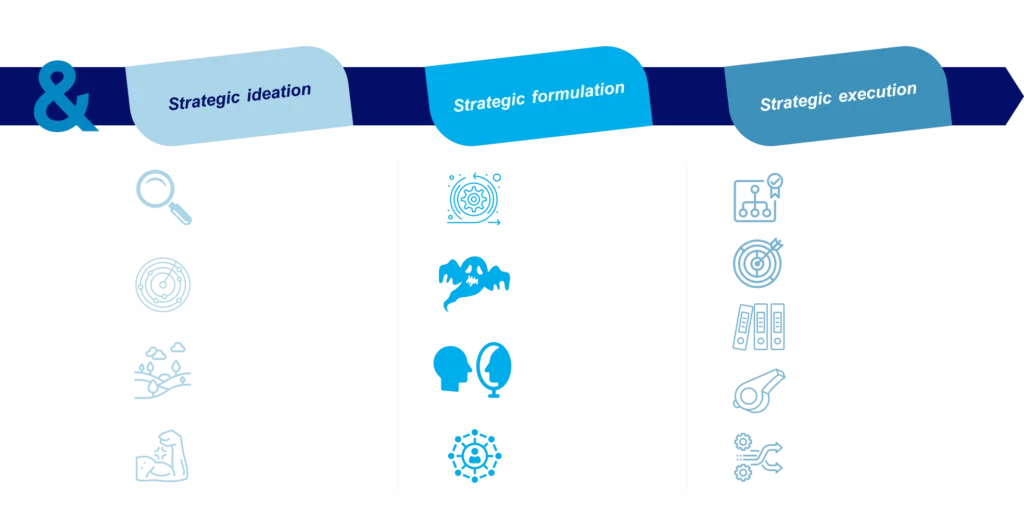
Strategic ideation
Different analyses support the development of a strategy. We accompany our clients from the understanding of the market context and compettive landscape to the identification of levers to unlock their full potential. Along the way, we identify trends that pose risks and/or opportunities, developing relevant scenarios to guide decision-making.
Strategic formulation
By understanding the diversity of our clients’ contexts and needs, we adopt multiple approaches to formulate customized strategies. With Agile Strategy, we swiftly identify strategic paths and options through a series of workshops. In “Nightmare Competitor”, we develop innovative business models with external expert support . In addition, we assist organizations in “Strategic Reflections” to identify strengths and gaps, and assess their positioning, as well as in drawing up a broader plan, “Comprehensive Strategy”, which includes defining objectives, goals, programs and specific actions.
Strategic execution
A strategy demonstrates its effectiveness to the extent that its execution is successful. To this end, Mirow applies a variety of resources to ensure the proper implementation of its projects. We offer support from the definition of governance and strategic monitoring models to “Change management” actions, such as training, capacity building, and incentives. Moreover, we support the launch of strategic initiatives, including planning sprints and working together with client teams.
How we use AI
What artificial intelligence changes in the method
- Trend radarContinuous sweep of public sources — regulation, sector publications, competitor and investment moves — with AI-assisted triage and classification. In practice, the first strategy discussion starts with the material already organised, instead of spending the project's opening weeks on fact-finding.
- Reading the client's own archiveStudies, minutes, models and older presentations are read and structured while preserving the origin of every figure — document, page and excerpt. That makes “where did this number come from?” answerable at any point in the project, months later included.
- Verification before deliveryEvery quantitative claim in the material is checked against the source it cites, and whatever does not reconcile goes back for review instead of going to the client.
In every case AI shortens the fact-finding and widens the evidence base. The judgement — what the evidence means for that company and what to decide from it — remains consulting work, done together with the client's team.
Cases
Examples of work

We developed a growth strategy for a company in the pulp and paper sector, identifying potential revenue increase of 65%

We developed a new business in distributed generation for a client in the energy sector, with the potential to increase valuation by US$200 million